Why I Never Skip This 4-Move Routine at 50 — And You Shouldn’t Either
Turning 50 made me realize something: my body doesn’t bounce back like it used to. Joints creaked, energy dipped, and I felt older than I looked. That’s when I committed to a simple, science-backed movement plan focused on longevity, not intensity. After six months of consistent practice, the changes weren’t flashy—but they were real. Better balance, smoother daily movements, and a sense of strength I thought I’d lost. This is what actually works to age well, without gimmicks or extremes.
The Silent Crisis of Aging Muscles (Sarcopenia)
As we move through our 30s and into our 40s, an invisible shift begins to take place within our bodies—muscle mass slowly declines at a rate of about 3% to 5% per decade. By the time most people reach 50, this loss accelerates significantly, a condition known as sarcopenia. It’s not just a cosmetic concern; it directly affects how we live day to day. The ability to rise from a chair without using your hands, climb a flight of stairs without pausing, or carry a bag of groceries from the car begins to diminish. These small challenges, once effortless, become daily reminders of physical decline.
Sarcopenia impacts more than mobility—it also alters metabolism. Muscle tissue is metabolically active, meaning it burns calories even at rest. As muscle decreases, so does the body’s ability to manage weight and regulate blood sugar. This contributes to a higher risk of insulin resistance and metabolic syndrome, conditions that become increasingly common in midlife. Additionally, weaker muscles compromise balance, increasing the likelihood of falls—a leading cause of injury among older adults. The good news is that sarcopenia is not an inevitable fate. Research consistently shows that regular, targeted movement can slow, and even reverse, muscle loss.
What makes this decline so insidious is that it happens gradually, often without immediate symptoms. People may not notice the change until a simple task—like getting up from the floor or reaching for a high shelf—becomes difficult. This delayed awareness means many wait too long to act. But the earlier one begins resistance and functional training, the more muscle can be preserved. The body remains capable of adaptation well into later life. Studies published in journals such as the Journal of the American Geriatrics Society confirm that strength training in adults over 50 leads to measurable gains in muscle size and function. The key lies in consistency and choosing the right type of movement.
Why Traditional Workouts Fall Short for Anti-Aging
In recent years, high-intensity interval training (HIIT), CrossFit, and heavy weightlifting have dominated fitness culture. While these methods can be effective for younger individuals seeking peak performance, they often do more harm than good for those in midlife and beyond. The body’s recovery capacity slows with age. Tendons become less elastic, joints lose cartilage, and inflammation takes longer to resolve. Pushing too hard can lead to overuse injuries, joint pain, or discouragement after an early setback.
Moreover, many traditional workouts focus on aesthetics—building visible muscle or burning calories—rather than functional ability. But for someone over 50, the goal isn’t to look like a fitness model; it’s to remain independent, mobile, and resilient. A workout that leaves you sore for days or unable to perform daily tasks defeats the purpose. What’s needed is a shift in mindset: from chasing intensity to cultivating sustainability. The most effective anti-aging fitness strategies prioritize joint health, movement quality, and long-term adherence over short-term results.
Science supports this approach. A longitudinal study from the National Institute on Aging found that moderate, consistent physical activity—such as walking, light resistance training, and balance exercises—was more strongly associated with longevity than sporadic intense workouts. Participants who engaged in daily low-impact movement had lower rates of cardiovascular disease, better cognitive function, and improved quality of life. The lesson is clear: for aging well, consistency trumps intensity. Movement should enhance life, not interfere with it. The ideal routine is one that can be performed safely every day, without requiring a gym membership or specialized equipment.
The Core Principles of an Anti-Aging Movement Plan
An effective anti-aging movement strategy rests on four foundational pillars: strength, mobility, balance, and functional movement. Each plays a distinct yet interconnected role in maintaining physical independence. Strength preserves muscle mass and supports bone density, reducing the risk of osteoporosis. Mobility ensures joints move through their full range, preventing stiffness and improving posture. Balance enhances stability, decreasing the chance of falls. Functional movement trains the body to perform real-life activities with ease—lifting, bending, reaching, and stepping.
These principles are not abstract concepts; they translate directly into everyday capabilities. Consider lifting a suitcase into an overhead bin. This simple act requires shoulder mobility, core strength, and coordination. Or imagine walking on uneven ground—such as a gravel path or a sloped driveway. This demands dynamic balance and ankle stability, both of which decline with age if not maintained. Another common challenge is getting up from the floor, a motion that tests leg strength, hip flexibility, and balance. The ability to do so safely is a strong predictor of overall physical resilience.
What ties these elements together is consistency and low-impact execution. High-force movements may build strength quickly but often at the cost of joint wear. Instead, the focus should be on controlled, deliberate motions that build body awareness. This means moving slowly enough to feel muscle engagement, breathing steadily, and avoiding jerky or rushed actions. Over time, this mindful approach leads to greater neuromuscular efficiency—the brain’s ability to recruit the right muscles at the right time. The result is smoother, more confident movement in daily life.
My Daily 15-Minute Routine (The 4 Essential Moves)
The routine I’ve followed for the past year takes just 15 minutes and requires no equipment. It targets the four pillars of anti-aging fitness and can be done at home, in socks or bare feet, with minimal space. The four moves are: bodyweight squat, step-up, standing balance reach, and wall push-up with shoulder glide. Each was chosen for its ability to address common weaknesses that emerge after 50.
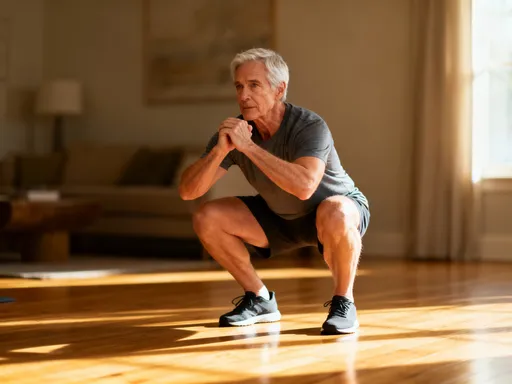
The bodyweight squat strengthens the quadriceps, glutes, and core—muscles essential for rising from chairs and climbing stairs. To perform it, stand with feet hip-width apart, toes slightly turned out. Lower the hips back and down as if sitting into a chair, keeping the chest lifted and knees aligned over the toes. Go only as deep as comfortable, then push through the heels to return to standing. For those with knee sensitivity, a chair can be placed behind for support. Over time, depth and control improve. This movement also enhances hip mobility and teaches proper loading of the lower body.
The step-up builds unilateral leg strength and improves coordination. Using a sturdy step or low bench (4–6 inches high), step one foot onto the surface, press through the heel to lift the body up, then bring the other foot to meet it. Step down with control, leading with the same foot. This mimics stair climbing and challenges balance. For beginners, holding onto a railing is acceptable. As strength increases, the step height can be raised slightly. This exercise is particularly effective because it works each leg independently, correcting imbalances that often go unnoticed.
The standing balance reach enhances stability and proprioception—the body’s sense of where it is in space. Stand on one leg, slightly bending the knee of the standing leg. Slowly reach the opposite hand across the body toward the opposite foot, then return to center. This dynamic motion challenges the core and ankle stabilizers. For added difficulty, perform it on a slightly soft surface, like a folded towel. This movement directly supports confidence when walking on uneven terrain or turning quickly. Even small improvements in balance can significantly reduce fall risk.
The wall push-up with shoulder glide strengthens the chest, shoulders, and arms while improving scapular mobility. Stand facing a wall, arms extended at shoulder height, palms flat. Lean toward the wall, bending the elbows, then push back to start. The key is to allow the shoulder blades to move—gliding apart as you lean in, then together as you push out. This maintains healthy shoulder mechanics, which are crucial for reaching overhead, opening jars, or pushing a vacuum. For more resistance, the exercise can be done on a countertop or stairs. Unlike floor push-ups, this version is gentle on the wrists and spine.
I perform two to three sets of 10–12 repetitions for each exercise, moving at a steady pace. The entire routine takes about 15 minutes and can be done in the morning or evening. I’ve noticed that doing it consistently—even on days when I don’t feel like it—leads to cumulative benefits. My posture is straighter, my steps are more confident, and I no longer hesitate before standing up from the couch. The key is not perfection but regularity.
How to Build a Habit That Sticks—Without Motivation
Motivation is fleeting. Relying on how you feel each day is a recipe for inconsistency. Instead, building a lasting movement habit depends on structure and environment. One of the most effective strategies is habit stacking—pairing a new behavior with an existing routine. For example, I do my 15-minute movement sequence right after brushing my teeth in the morning. Because tooth brushing is non-negotiable, the movement routine benefits from that automaticity.
Another powerful tool is environmental design. I keep a small mat in the corner of my living room, visible and ready to use. Seeing it serves as a visual cue, reducing the mental effort required to begin. I also wear workout clothes during the day if I know I might struggle with energy later. These small changes remove friction and make action easier. Research in behavioral psychology shows that people are more likely to stick with habits when the barriers to entry are low.
Common mental blocks—“I don’t have time,” “I’m too stiff,” “I’ll start tomorrow”—are natural but can be overcome. Time is not the real issue; most people can find 15 minutes. The real obstacle is often discomfort with starting. The solution is to redefine success: not by how many reps you do, but by showing up. Even doing one set of each exercise counts as a win. Over time, these small victories build confidence and reinforce the identity of someone who moves every day.
Tracking progress can also help. I use a simple calendar, marking each day I complete the routine. The visual chain of checkmarks becomes its own motivator—no one wants to break the streak. But the deeper reward is how I feel: more capable, more alert, more in control of my body. This internal feedback loop is far more powerful than any external reward.
Listening to Your Body: The #1 Rule of Aging Well
One of the most important skills in midlife fitness is learning the difference between discomfort and pain. Discomfort—such as muscle fatigue or mild soreness—is normal and often a sign of adaptation. Pain—sharp, localized, or joint-related—is a warning signal. Pushing through pain increases the risk of injury and can set back progress by weeks or months. The goal is not to endure but to understand.
Body awareness begins with simple cues: Is your breath shallow or held? Are your shoulders tense? Is your movement jerky or smooth? These signals provide real-time feedback. If breathing becomes strained, slow down. If a joint feels pinched, adjust your form. If fatigue sets in early, reduce the number of repetitions. The routine should leave you feeling energized, not drained.
Rest and recovery are not signs of weakness; they are essential components of progress. Muscles grow and repair during rest, not during exercise. Overtraining leads to inflammation, sleep disruption, and burnout. I’ve learned to honor rest days and to modify the routine when needed—perhaps doing only two of the four moves on a tired day. This flexibility ensures long-term adherence. Fitness at this stage is not about pushing limits but about maintaining function and preventing decline.
Finally, this journey is personal. Comparing yourself to others—whether a younger sibling, a fit friend, or an online influencer—is counterproductive. Every body ages differently. The only meaningful comparison is to your own past. Did you stand up more easily today? Did you carry the laundry basket without setting it down? These small improvements are the true markers of success.
Beyond Exercise: How Movement Fits Into Holistic Anti-Aging
Physical movement does not exist in isolation. It interacts deeply with other aspects of health—sleep, mood, metabolism, and mindset. Regular activity improves sleep quality by helping regulate the body’s circadian rhythm. People who move consistently tend to fall asleep faster and experience deeper, more restorative sleep. Better sleep, in turn, supports hormone balance, cognitive clarity, and emotional resilience.
Mood is another beneficiary. Exercise increases the production of endorphins and other neurotransmitters linked to well-being. For many women in midlife, this can be especially valuable during hormonal transitions that affect mood and energy. Movement provides a natural, accessible way to stabilize emotions without medication. It also fosters a sense of agency—the feeling that you are actively caring for yourself.
Nutrition plays a supporting role. While no specific diet is recommended here, adequate protein intake is essential for muscle maintenance. The body’s ability to synthesize protein decreases with age, so consuming high-quality protein throughout the day—such as eggs, Greek yogurt, legumes, or lean meats—supports muscle repair. Hydration is equally important; even mild dehydration can impair balance and cognitive function.
Stress management and mindset complete the picture. Chronic stress accelerates aging by increasing inflammation and cortisol levels. Mindful movement—such as the slow, deliberate exercises in this routine—acts as a form of moving meditation, calming the nervous system. Over time, the act of showing up for yourself builds self-trust. You begin to see movement not as a chore or punishment, but as an act of self-respect. This shift in perspective is perhaps the most powerful anti-aging tool of all.
This isn’t about turning back time. It’s about moving through it with strength, grace, and independence. The real goal of anti-aging isn’t to look younger—it’s to live fully at every age. By embracing a simple, smart movement practice, you invest in your future self every single day. And that’s a habit worth keeping.